
Is Iris Photography a Security Risk? Why Sharing Your Eye Photo Won’t Get You Hacked
We need to talk.
Every time I set up a mobile iris photography pop-up, I get to meet some incredible people and photograph some truly magnificent, cosmic-looking eyeballs. But lately, my soul has been quietly weeping into my camera gear.
Why? Because when it comes time to fill out my model release form, a tragic number of you are ticking the “Do Not Share” box.
I get it. You look at the final, mind-blowingly detailed print of your eye and your brain immediately jumps to a sci-fi thriller scenario: “If Elton posts this on Instagram, a rogue hacker in a dark room is going to scan it off a smartphone screen, bypass MI6 security, and drain my current account.”
It’s a deeply flattering assumption about the quality of my macro lens, but from a security standpoint, it’s completely unnecessary. Let’s look at the actual science, math, and logic behind why sharing your gorgeous iris photography on social media poses absolutely zero security risk to your identity.
1. Apple and Android Don’t Care About Your Iris anyway
First things first: what tech are you actually trying to protect?
If you are worried about your smartphone, take a look at it. If you have an iPhone, it uses FaceID, which scans the 3D geometry of your entire face, depth-mapped with infrared dots. It doesn’t unlock by staring at a 2D close-up of your cornea. Even Android devices that offer “iris scanning” require a live, blinking, 3D biological entity to work.
A flat, beautifully lit JPEG posted to my social channels is about as useful to a phone scanner as a drawing of a key is to a physical deadbolt.


2. The Tech Reality: Biometric Scanners Need “Live” Data
Let’s pretend for a moment that you do work for a high-security government facility that uses biometric iris scanning to let you into the building.
High-end biometric security systems do not work like a barcode scanner at a Tesco self-checkout. They use near-infrared (NIR) light illumination to map the deep structure of the eye. More importantly, they look for liveness detection. They measure pupillary hippos (the micro-oscillations and involuntary constrictions of a real pupil responding to light) and the actual curvature of the cornea.
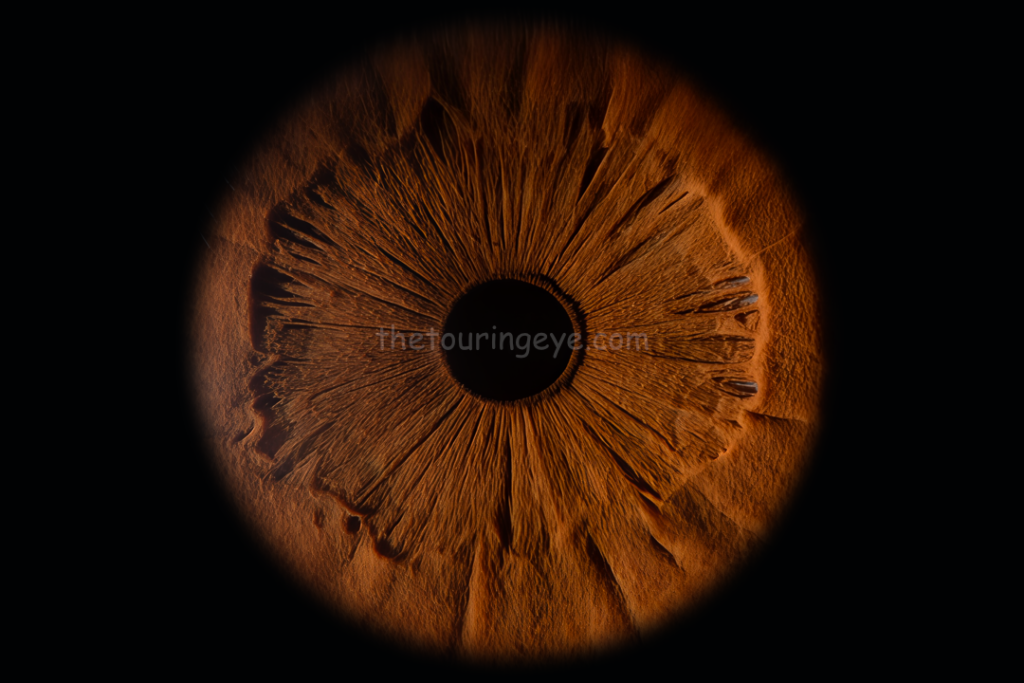
My high-resolution macro photography captures the breathtaking art of your eye, but it cannot capture life. A static image uploaded to Instagram lacks the multi-spectral, dynamic data required to trick even the most basic commercial biometric scanner.
3. The Digital Shredder: How Social Media Destroys Data
Even if a super-villain wanted to try and harvest your iris data from my social media channels, technology itself steps in to thwart them.
When I upload an image to Instagram, Facebook, or TikTok, their compression algorithms immediately kick in. Social media networks aggressively compress, flatten, and strip down image files to save server space.
By the time a photo hits your feed, it has lost the raw, pixel-level depth data required to reconstruct a mathematical biometric template. It becomes a beautiful piece of art for human eyes to admire, but absolute gibberish to an AI biometric scanner.
4. The Photoshop Process (Or, How I Gently Mess with the Metrics)
While I never remove the gorgeous, naturally occurring landmarks that make your eye uniquely yours—like a stunning iris freckle (nevus) or beautiful colour heterochromia—my hand-editing process inherently breaks the mathematical uniformity a computer looks for.
When I edit your photo, I am cleaning up the technical imperfections. I use tools to alter pupil size, and I actively remove “burnout” highlight areas where a flash has hit a reflection at an awkward, overexposed angle. I also clear out distracting reflections from eyelashes bouncing light into the eye.
By removing these specific ambient lighting metrics and altering the pupil dilation to make the final piece look visually spectacular, the image loses the exact real-world environmental data a scanner would expect from a live capture.
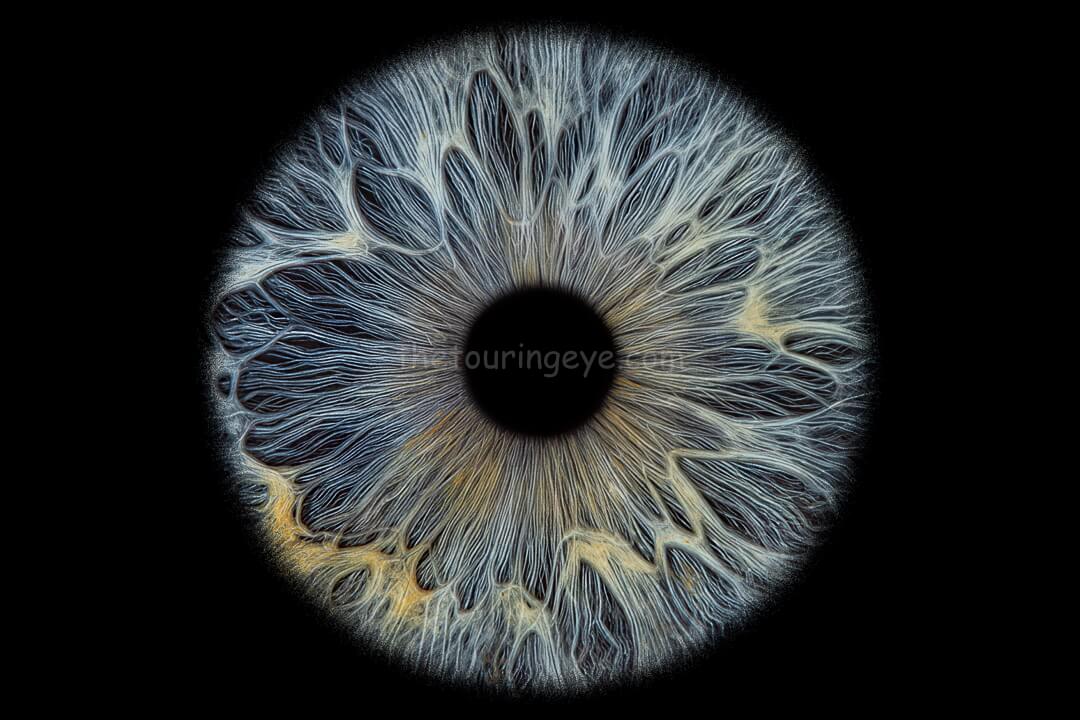

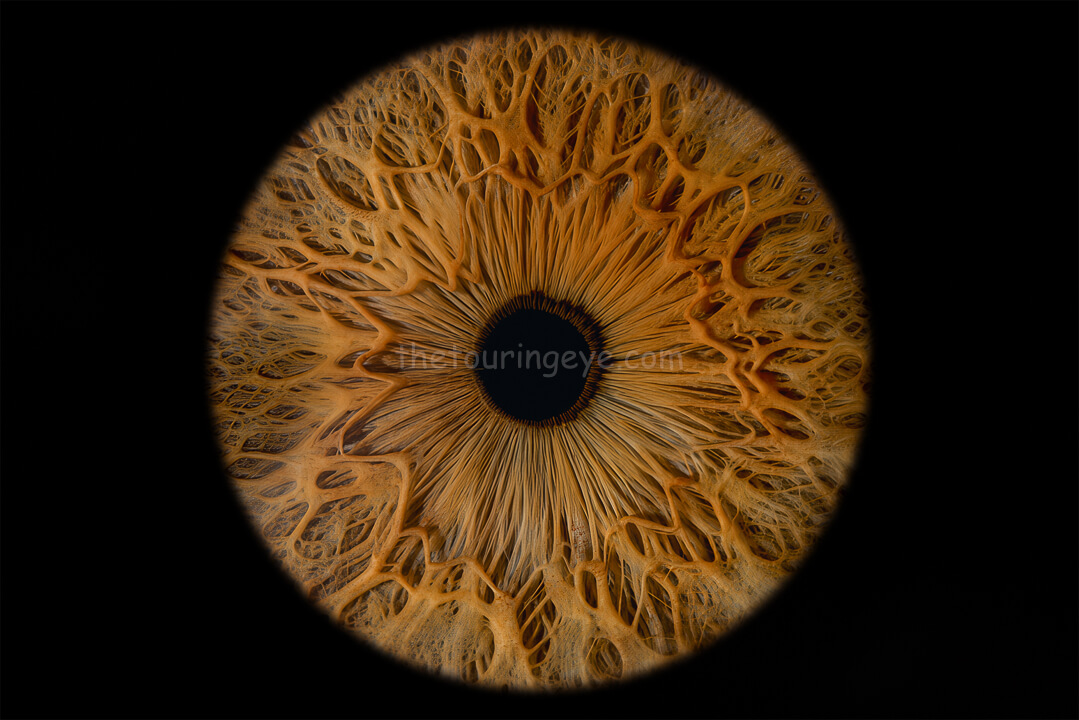
The Absolute Worst-Case Scenario? Your Friends Might Think You Have Nice Eyes.
To a random stranger on the internet, a cropped image of an iris is completely anonymous. There are no eyebrows, no face shape, and no skin texture. It is a stunning, abstract universe in a circle.
If I post a collection of five eyes from a recent pop-up event, the only people on earth who could ever hope to guess which one is yours are your closest family or friends—and that’s only if they already know you attended my event and happen to know you have a distinct brown speck at the 4 o’clock position in your left eye.
Your identity is completely safe. Your bank account is safe. Your top-secret government clearance is safe.
The only thing that actually happens when you opt-out of my model release form is that the world misses out on seeing a truly epic piece of natural art, and I am left staring at an incredible photo on my hard drive that I’m legally forbidden from showing off.
So, next time you visit a pop-up, go ahead and tick that consent box. Let’s show the world how incredible your eyes look—secure in the knowledge that no one is hacking your life because of it.
Leave a Reply
You must be logged in to post a comment.