

You have just received your iris photography images, opened the gallery, looked at the detail, zoomed in, squinted slightly, possibly questioned reality itself, and thought:
“Are you sure that’s my eye?”
A fair question.
Most people have never seen their eye photographed in extreme close-up, under controlled lighting, with the kind of detail normally reserved for medical imaging, biometric scans, or those nature documentaries where an ant suddenly looks like it pays rent.
So, before you start wondering whether I’ve accidentally sent you someone else’s eyeball, let’s go through why your iris photograph may look different from the eye colour you are used to seeing in the mirror.
The short answer is this: yes, it is your eye. But it is your eye photographed under conditions very different from normal everyday life.
And that makes a much bigger difference than most people expect.
Why Your Iris Photo Can Look Different From Your Everyday Eye Colour
In daily life, you normally see your eyes in fairly soft, uneven, ordinary lighting. Bathroom lights, daylight through a window, car mirrors, phone selfies, cloudy skies, pub toilets with lighting apparently designed by a vengeful electrician — all of these affect how your eye colour appears.
Iris photography is completely different.
During a session, your eye is photographed very close up using flash lighting, a macro lens, and a controlled setup designed to reveal the texture, pigment, fibres and patterns inside the iris. This does not create fake colour, but it can reveal colour and detail that is usually hidden in normal lighting.
Your eye colour is not a single flat colour, like paint from a tin. It is created by pigment, structure, light absorption, light reflection and scattering. In plain English, your iris is more complicated than “brown”, “blue”, “green” or “hazel”.
Annoying? Slightly.
Beautiful? Usually, yes.
Simple? Absolutely not.
Your Eye Colour Is Not One Solid Colour
Most people describe their eyes using one broad label. Brown. Hazel. Blue. Green. Grey.
That is useful in conversation, but it is not how the iris actually behaves in close-up photography.
Your iris may contain several tones at once, including amber, gold, copper, green, blue-grey, dark brown, light brown, yellow, olive, or even tiny areas that look almost silver under flash.
This is especially noticeable in hazel and brown eyes.
A hazel eye may look brown indoors, green outdoors, amber in sunlight, and much lighter in flash photography. A brown eye may appear dark brown in normal life but show amber, honey, copper or golden tones when photographed closely.
This does not mean the photograph has changed your eye colour. It means the lighting has revealed pigment and structure you do not normally see.
Think of it like photographing a landscape at sunrise. The hill has not changed. The light has.
Why Hazel Eyes Often Look Lighter in Iris Photography
Hazel eyes are wonderfully awkward. I say this with affection, obviously, because hazel eyes are often among the most interesting to photograph.
They are also the eyes most likely to make someone say:
“That looks too green.”
“That looks too blue.”
“My eyes are darker than that.”
“Are you sure that’s mine?”
Hazel eyes often contain a mixture of brown, green, amber and sometimes blue-grey tones. In normal lifestyle settings, the brown or amber tones may dominate because they absorb more light and visually overpower the lighter colours.
Under flash photography, however, more light enters the iris and reflects back into the camera. This can make the lighter areas more visible. Greens may appear brighter. Blue-grey tones may become more obvious. Amber pigment can look golden.
The result is not a false colour. It is a different view of the same eye.
In standard everyday lighting, hazel eyes often look warmer, darker and more blended. In iris photography, the individual colour zones can separate visually, making the eye appear lighter or more complex than expected.
This is why a hazel eye that looks “mostly brown” in a mirror can look green, gold, blue-grey or amber in a detailed iris image.
No, I have not swapped your eye with a woodland fairy. That would be deeply inefficient and probably bad for repeat business.


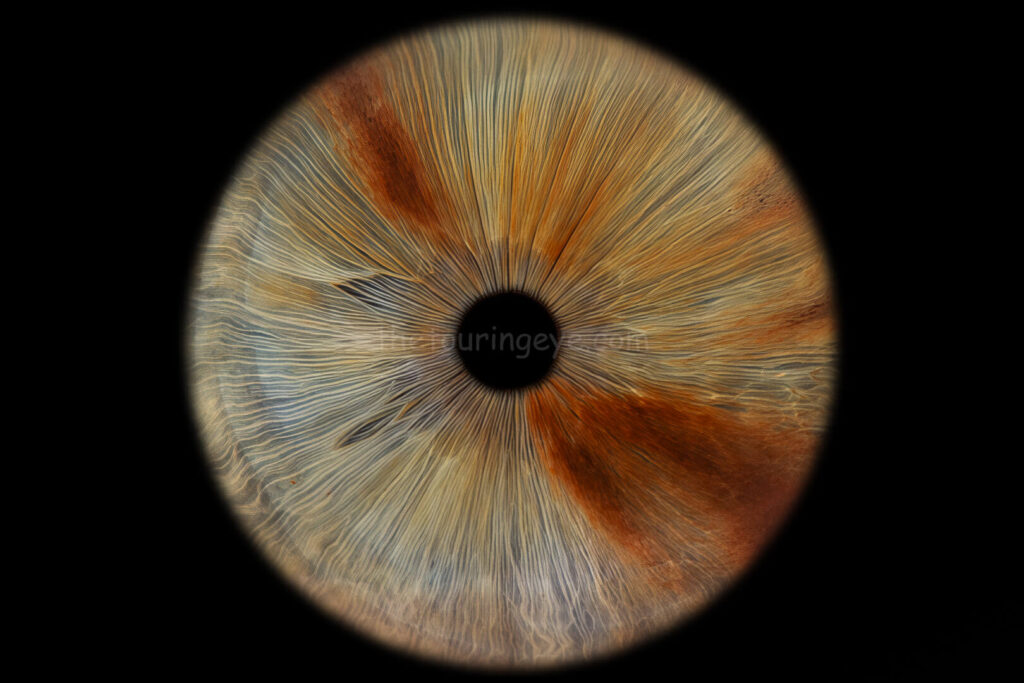
Why Brown Eyes Can Look Amber, Gold or Copper
Brown eyes are some of the most challenging eyes to photograph well.
Not because they are less interesting. Quite the opposite. Brown eyes often contain incredible texture, depth and pigment variation, but much of that detail is hidden because darker pigment absorbs more light.
In everyday settings, a brown eye may simply look dark brown. Under close-up flash photography, however, the camera can capture subtle colour variation that is normally difficult to see.
This is why brown eyes may appear:
- amber
- honey-toned
- golden brown
- copper
- chestnut
- reddish brown
- lighter around the pupil
- darker around the outer edge
This is very normal.
The flash does not magically turn a brown eye into an amber eye. What it does is illuminate the pigment and reveal the reflective qualities of the iris surface.
Brown eyes can also reflect surrounding colours more strongly during close-up photography. The surface of the eye is naturally glossy, because the cornea sits in front of the iris. That glossy surface can pick up reflections from lights, clothing, equipment, the room, or anything nearby.
This is one reason brown eyes can be more difficult to photograph than lighter eyes. They can reflect almost everything around them, because apparently the eye decided being beautiful was not enough — it also wanted to become a tiny, curved mirror.
Why Flash Photography Changes What You See
Flash is not used in iris photography to alter the eye. It is used to reveal detail.
A controlled flash provides a short, bright burst of light that allows the camera to capture fine iris fibres, texture, pigment patterns and colour variation. Without enough light, much of this detail would disappear into shadow, especially in darker eyes.
This is also why your iris photograph may look brighter than your eye appears in a mirror. The image is showing the iris under direct, controlled lighting rather than casual ambient light.
In other words, your iris photograph is not trying to represent how your eye looks across a dinner table in a softly lit restaurant. It is showing what your iris looks like when photographed closely and deliberately for detail.
Those are not the same thing.
One is normal appearance.
The other is a detailed photographic study.
Both can be true.
Your Pupil Size Can Change the Look of the Iris
Another important point is pupil size.
Your pupil is the black opening in the centre of your eye. It gets larger in darker conditions and smaller in brighter conditions. When the pupil changes size, the surrounding iris tissue stretches or compresses slightly.
This can change how the patterns appear in a photograph.
When your pupil is smaller, more of the iris may be visible. When your pupil is larger, some of the iris area is reduced because the black centre takes up more space. This can alter the balance of colour and texture that you see in the final image.
So if your iris photograph looks different from what you expected, part of that may simply be because your eye was responding to the lighting conditions at the time.
Again, this does not mean the image is wrong. It means your eye is doing what eyes do.
Annoying little overachievers.
Why One Eye May Look Different From the Other
People often assume both of their eyes are identical.
They are often not.
Your left and right iris can have different patterns, pigment distribution, freckles, rings, colour zones, darker areas, lighter areas, and tiny structural differences. Sometimes this is obvious. Sometimes it is only visible in close-up photography.
Even when both eyes are broadly described as the same colour, they may photograph differently. One eye may contain more amber. The other may show more green. One may have a darker outer ring. The other may have more visible fibre detail.
This is completely normal.
Your irises are not mass-produced buttons. They are biological structures, and like most things in nature, they refuse to be perfectly symmetrical because apparently that would be too convenient.
Why Your Phone Screen May Affect What You See
Another thing to remember is that you are probably viewing your images on a phone, tablet or computer screen.
Screens are not always accurate.
Some phones automatically boost colour and contrast. Some screens are warmer. Some are cooler. Some are set to night mode. Some have brightness turned right down. Some are calibrated beautifully. Others are about as reliable as a weather forecast for a bank holiday.
This means your iris image may look slightly different depending on the device you use to view it.
For the most accurate viewing, look at the image on a good-quality screen with brightness set to a normal level and any colour-altering settings turned off. Night Shift, True Tone, Eye Comfort Shield, blue light filters and vivid display modes can all change the way colour appears.
If the image looks warmer, cooler, greener, brighter or darker on different devices, that is usually a screen issue, not an eye issue.
Does Editing Change the Colour of My Eye?
The purpose of editing is to prepare the image as a finished artwork while keeping the iris recognisable and true to the photograph taken during the session.
I do not use editing to randomly change brown eyes into blue eyes, hazel eyes into emerald green eyes, or anything equally dramatic and ridiculous.
Editing may involve cleaning the image, improving clarity, correcting distractions, preparing the crop, enhancing detail visibility, and creating the final artistic presentation. But the iris itself is based on the photograph captured at the session.
Special edits, such as explosion, infinity, clash, lava, ice or other creative artwork styles, are more artistic by nature. However, the iris detail remains the foundation of the design.
The aim is always to create something beautiful from your actual eye, not to invent a new one because I got carried away like a Photoshop wizard with a caffeine problem.
Why Iris Photography Is Not the Same as a Mirror
A mirror gives you a general impression of your eye colour.
Iris photography gives you detail.
That is the key difference.
When you look in a mirror, you are usually seeing both eyes from a distance, surrounded by skin, eyelashes, eyebrows, facial expression and ambient lighting. Your brain simplifies the colour into a familiar label.
When your iris is photographed close up, everything else is removed. You are looking directly at the colour structure and texture of the iris itself.
This can feel surprising because the image isolates something you normally only see as part of your face.
It is similar to seeing a macro photograph of a leaf, feather, flower or insect wing. From a distance, you think you know what it looks like. Up close, the detail can look almost unreal.
But it is not unreal.
It is simply detail you do not normally get to see.
“But My Eyes Are Dark Brown”
They may well be.
In normal life, your eyes may absolutely appear dark brown. That is a valid description.
But under close-up flash photography, that same dark brown iris may reveal amber, gold, copper, reddish-brown or honey tones.
This does not mean your eyes are not brown. It means brown eyes are not always just one flat shade of brown.
The word “brown” covers a huge range of pigment. A dark brown iris can contain lighter pigment structures that only become visible under strong, directed light.
So if your final image looks warmer or more amber than expected, that does not automatically mean the colour is wrong. It may simply mean the photography has revealed the hidden tones within your brown eye.


“But My Eyes Are Hazel, Not Blue or Green”
Hazel eyes can be particularly confusing because they often shift appearance depending on light.
A hazel eye may look brown indoors, green in daylight, golden in the sun, and much lighter in flash photography. Some hazel eyes also contain blue-grey or cool-toned areas that are not obvious in everyday settings.
So if your hazel iris photograph appears to show pale green, blue-grey, gold or amber areas, that does not necessarily mean the photograph is inaccurate.
It means your eye contains more colour variation than you may have realised.
Hazel eyes are not one colour. They are usually a blend. That blend can behave very differently depending on the lighting.
Because obviously one eye colour was too easy.
“Could You Have Sent Me the Wrong Eye?”
It is a reasonable question, and I understand why someone might ask it.
However, images are handled carefully and delivered according to the session details. After hosting 69 iris photography events, I have photographed a lot of eyes, and the most common doubts usually come from people with hazel or brown eyes because these are the colours most likely to look different under flash and macro photography.
That does not mean your concern is silly. It means your reaction is understandable.
Most people are simply not used to seeing their own iris this way.
If you are ever genuinely concerned, please do get in touch. I would much rather answer the question properly than have you sitting there wondering whether your eye has been replaced by a glamorous stranger’s.
But in most cases, the answer is simple:
Yes, that is your eye.
You are just seeing it under very different lighting, at a very different scale, with far more detail than you normally see.
Why Your Iris Image May Look More Dramatic Than Expected
Iris photography is part science, part photography, and part artwork.
The image is intended to show the beauty, structure and individuality of your eye. It is not meant to be a passport-photo-style record of your everyday eye colour under average lighting.
A passport photo says, “This person exists.”
An iris artwork says, “Good grief, there is an entire galaxy hiding in there.”
The drama comes from detail, light, texture, contrast and the fact that your iris is being treated as the main subject of the image rather than a tiny part of a face.
That difference matters.
Final Answer: Yes, It Is Your Eye
If your iris photograph looks lighter, brighter, warmer, more amber, greener, bluer or more detailed than you expected, that is usually because macro flash photography reveals colours and structures that are not obvious in normal daily life.
Hazel eyes can appear much lighter under flash.
Brown eyes can reveal amber, gold, copper or honey tones.
Screens can shift colour.
Pupil size can change the visible iris pattern.
Each eye can differ from the other.
And most importantly, your everyday eye colour and your detailed iris photograph can both be accurate in different contexts.
So yes — it is your eye.
It just turns out your eye had rather more going on than it had previously admitted.
Typical.
Leave a Reply
You must be logged in to post a comment.