
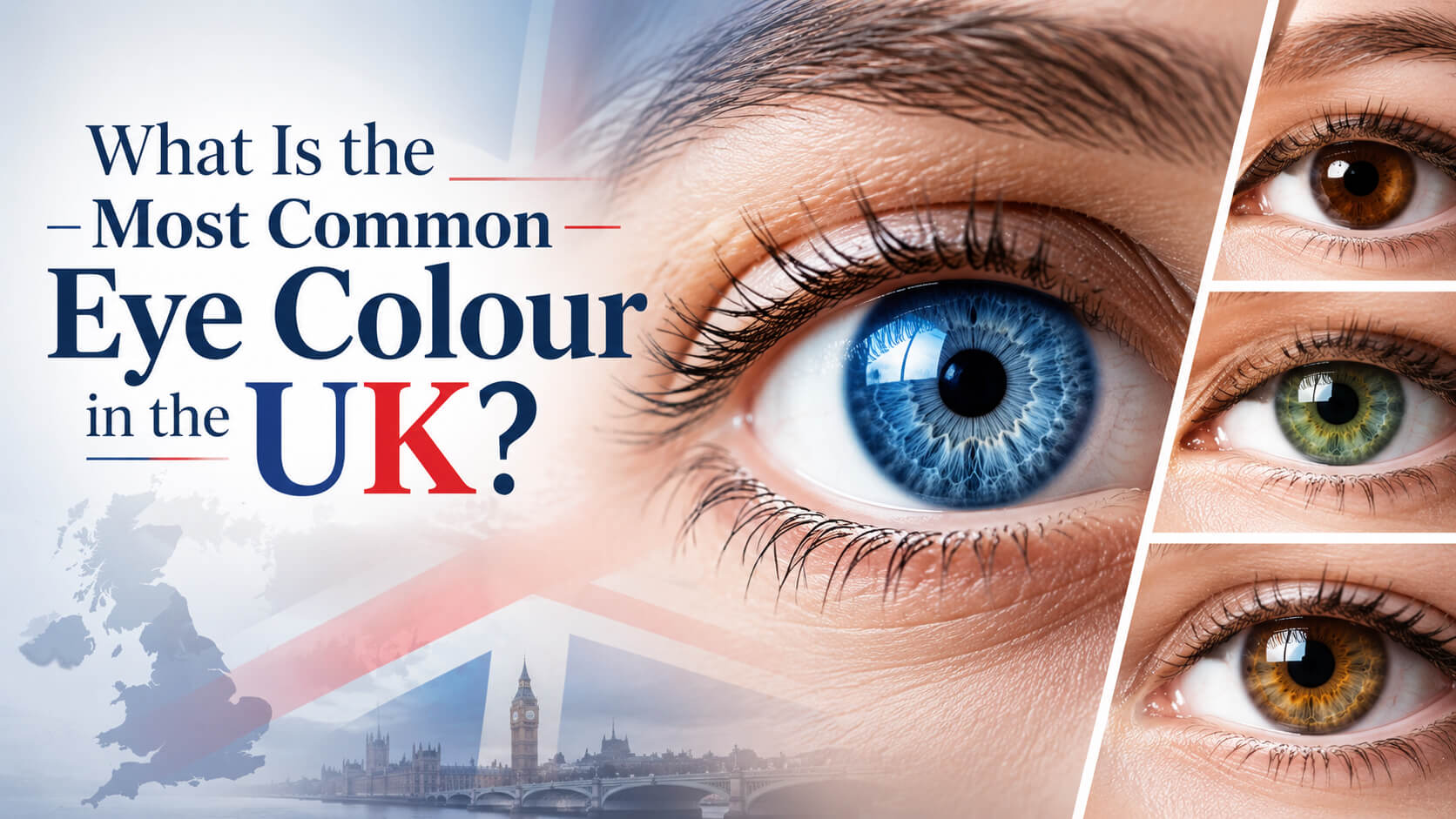
TL:DR
The most common eye colour in the UK is most likely blue. The best available published estimates for Great Britain suggest that blue or blue-grey eyes are more common than brown, hazel, green or intermediate eye colours. However, there is no official UK census of eye colour, so exact percentages should be treated as estimates rather than carved-in-stone fact. Annoying, yes. But science tends to prefer accuracy over pub-quiz confidence.
The short answer: blue is probably the UK’s most common eye colour
The most common eye colour in the UK is generally reported as blue, although the exact percentage depends on how eye colour is classified.
One major literature review on the geographical distribution of eye and hair colour listed Great Britain as having approximately 42.8% blue eyes, 31.77% brown eyes, and 25.46% intermediate eyes. In that review, “blue” also included grey, “brown” included hazel, and “intermediate” included green and yellow-toned eyes. So, based on that classification, blue is the largest category.
Another often-cited British estimate, from the Blue Eyes Project reported in 2014, suggested that Britain was around 48% blue-eyed, 30% green-eyed, and 22% brown-eyed. That estimate is widely repeated, but it should be used carefully because it is not the same as a large official government dataset or modern peer-reviewed UK population survey.
So the sensible answer is this:
Blue appears to be the most common eye colour in Britain and probably the UK, but exact UK-wide percentages are uncertain.
That may not be quite as satisfying as “48.003% of people have blue eyes and Dave from Norwich is the statistical tipping point”, but it is more honest. And honesty, while less clickable, does have the charming advantage of being true.
Why is it hard to give an exact UK percentage?
You would think this would be simple. The UK records plenty of information about people: age, sex, ethnicity, location, health, employment, housing, education, and whether the nation is collectively pretending the weather is “not too bad, actually”.
But eye colour is not routinely recorded in a national UK census.
That means there is no official, current, UK-wide database that tells us exactly how many people have blue, brown, green, hazel, grey or amber eyes. Most figures come from academic reviews, older datasets, genetic studies, commercial research projects, surveys, or articles that summarise other sources.
There is another complication: eye colour is not always neatly defined.
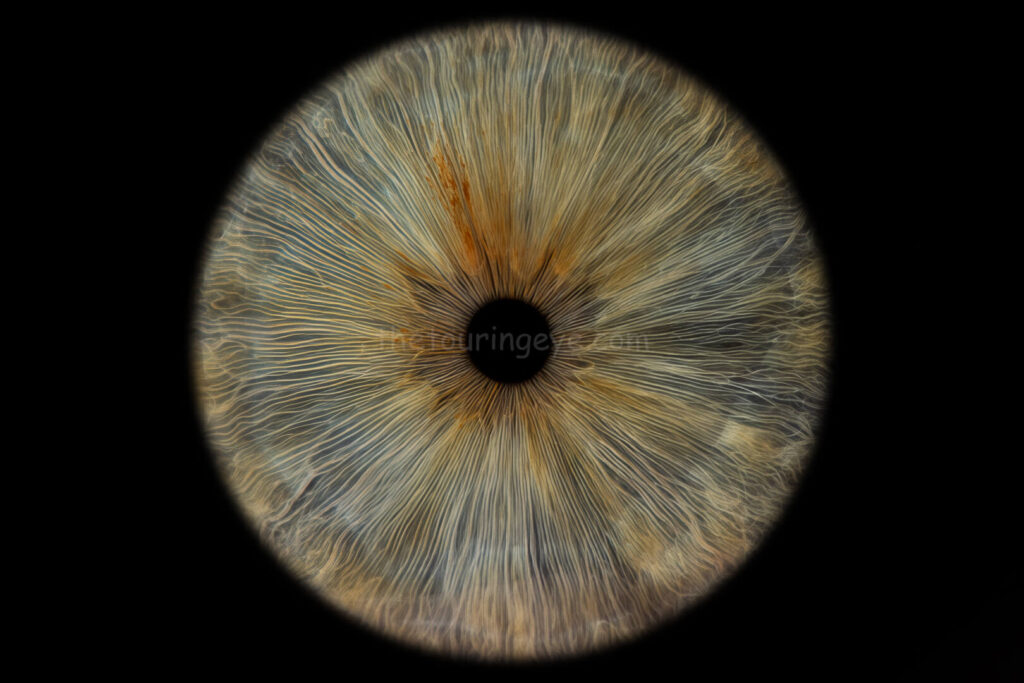
One person’s “green” is another person’s “hazel”. Grey eyes may be counted as blue. Hazel may be counted as brown. Green and amber may be put into an “intermediate” category. Some eyes contain several colours in different parts of the iris. Anyone who works closely with iris photography will know this immediately: eyes are not flat paint swatches from B&Q.
This is why you may see different figures online. They are not always directly comparable because they may be using different categories.
Large UK optician chains such as Boots Opticians, Specsavers and Vision Express publish plenty of eye-health advice, but I could not find any publicly available UK population statistics from them showing the distribution of natural eye colour. That is not surprising: eye tests are designed to assess vision and eye health, not to create a national eye-colour census. For that reason, this article relies on published population and genetics research rather than optician-chain marketing pages.
What does “blue eyes” actually mean?
Blue eyes are not blue because they contain blue pigment. That is one of those facts that sounds made up by someone trying to win an argument at a dinner party, but it is true.
Eye colour is mainly influenced by the amount and distribution of melanin in the iris. Melanin is the pigment that also contributes to skin and hair colour. Brown eyes have more melanin in the front layers of the iris. Blue eyes have much less melanin there, so light scatters through the iris structure in a way that makes the eye appear blue.
This is similar in principle to why the sky looks blue. No, your eyes are not tiny weather systems, but the physics is doing a similar sort of party trick.
Green, hazel and grey eyes are more complicated because they involve different levels of pigment, light scattering, and iris structure. That is one reason eye colour can look different depending on lighting, clothing, camera settings and editing.


Why are blue eyes so common in the UK?
Blue and other light eye colours are more common in northern and western Europe than in many other parts of the world. The UK population has deep historical ancestry links with European populations where lighter eye colours are relatively frequent.
That does not mean everyone in Britain has blue eyes, obviously. Walk through London, Birmingham, Manchester, Glasgow, Cardiff or Belfast and you will see the full human colour palette because the UK is genetically and culturally mixed, and has been shaped by migration for centuries.
But compared with the global population, the UK has a relatively high proportion of people with lighter eyes.
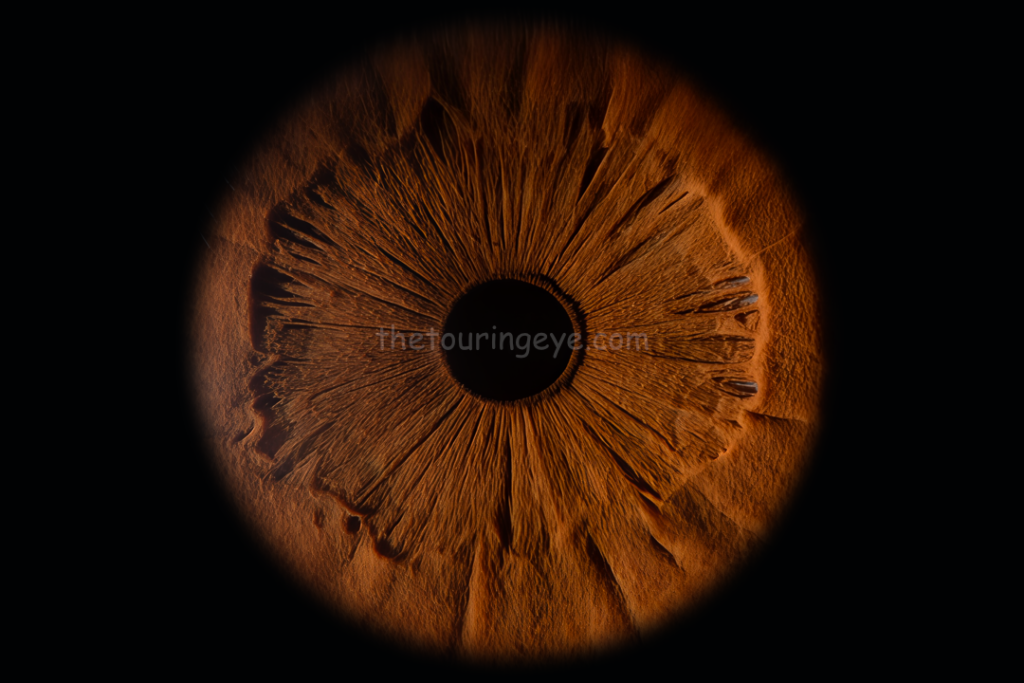
Globally, brown is the most common eye colour by a very large margin. That makes sense because brown eyes are common across Africa, Asia, the Middle East, South America and many other regions. In Britain, however, blue appears to edge ahead in the available estimates.
Is brown the most common eye colour in the world?
Yes. Worldwide, brown is the most common eye colour.
Most global estimates place brown far ahead of blue, green, grey, hazel and amber. The reason is simple: brown eyes contain more melanin, and darker eye colours are common in much of the world’s population.
This is why articles that say “brown is the most common eye colour” and articles that say “blue is the most common eye colour in Britain” can both be correct. They are talking about different populations.
Globally: brown wins.
In Britain: blue probably wins.
Geography matters. Population history matters. Genetics matters. Context matters. Which is deeply inconvenient for anyone trying to make a ten-second TikTok claiming there are only three facts you need to know.
What about green eyes in the UK?
Green eyes are often described as rare worldwide, and that is broadly true. However, they are more common in parts of Europe than in many other regions.
In the UK, green eyes are not as rare as some people assume. Depending on how the data is categorised, green may be counted separately or grouped into an “intermediate” category with hazel, amber or yellowish-brown tones.
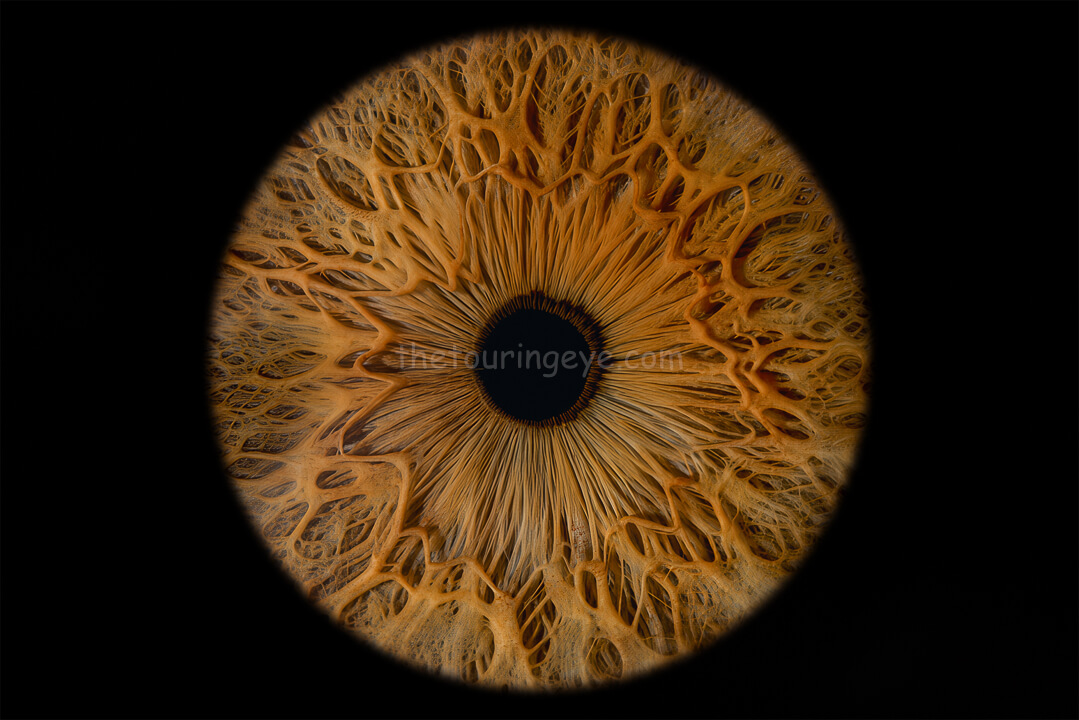
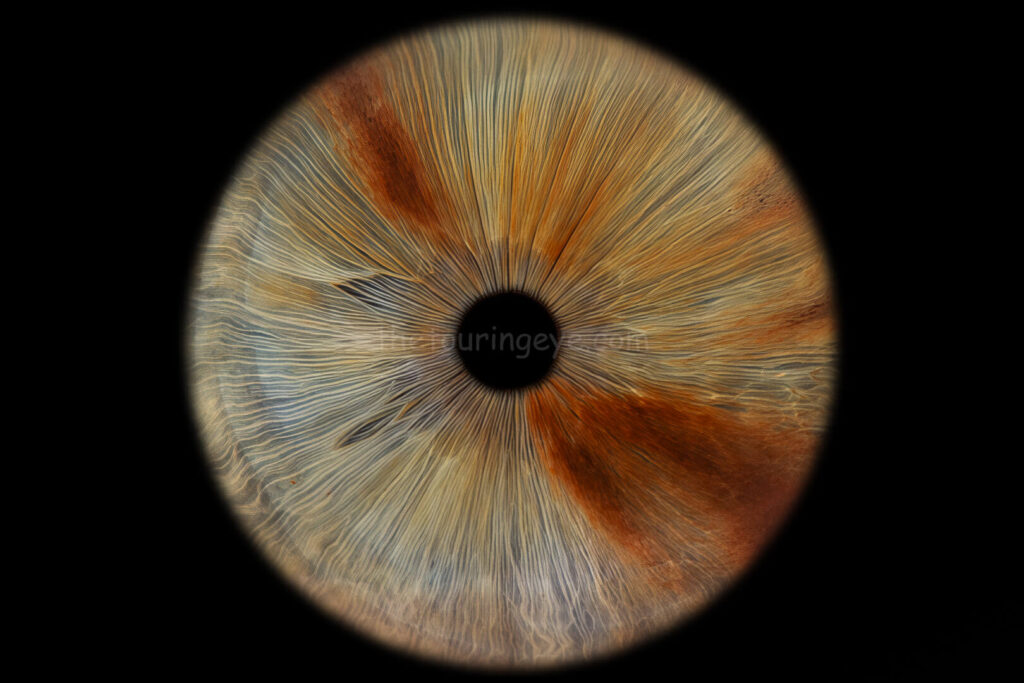
This matters because green and hazel can be difficult to separate in everyday observation. Many hazel eyes contain green. Many green eyes contain amber or brown near the pupil. Central heterochromia can make the inner ring of the iris a different colour from the outer iris. Under flash, sunlight or studio lighting, the same eye may appear greener, warmer, darker or more golden.
So when someone confidently says, “Green eyes are exactly X% of the UK population,” your eyebrow is allowed to do a small sceptical dance.
What about hazel eyes?
Hazel eyes are particularly awkward because the term is used inconsistently.
Some people use “hazel” to mean a light brown eye. Others use it to describe a mixture of brown, green and gold. Some studies group hazel with brown. Others treat it as intermediate. This creates a statistical mess, because naturally humanity looked at a complex biological trait and decided the best approach was vague colour naming. Excellent work, team.
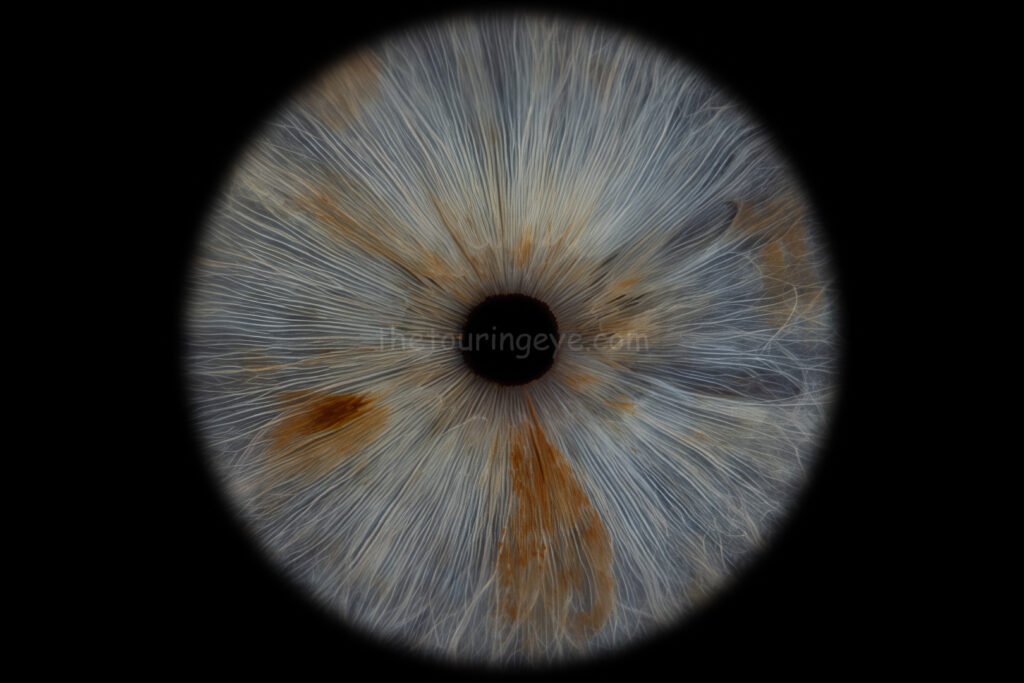
For iris photography, hazel eyes are often some of the most visually interesting because they can contain strong variation: amber around the pupil, green in the mid-iris, darker rings around the outside, and fine radial fibres that become far more visible under controlled lighting.
In ordinary conversation, hazel eyes are common enough in the UK that most people will know someone with them. In strict population statistics, however, they are difficult to count cleanly unless the study defines them clearly.
Are grey eyes common in the UK?
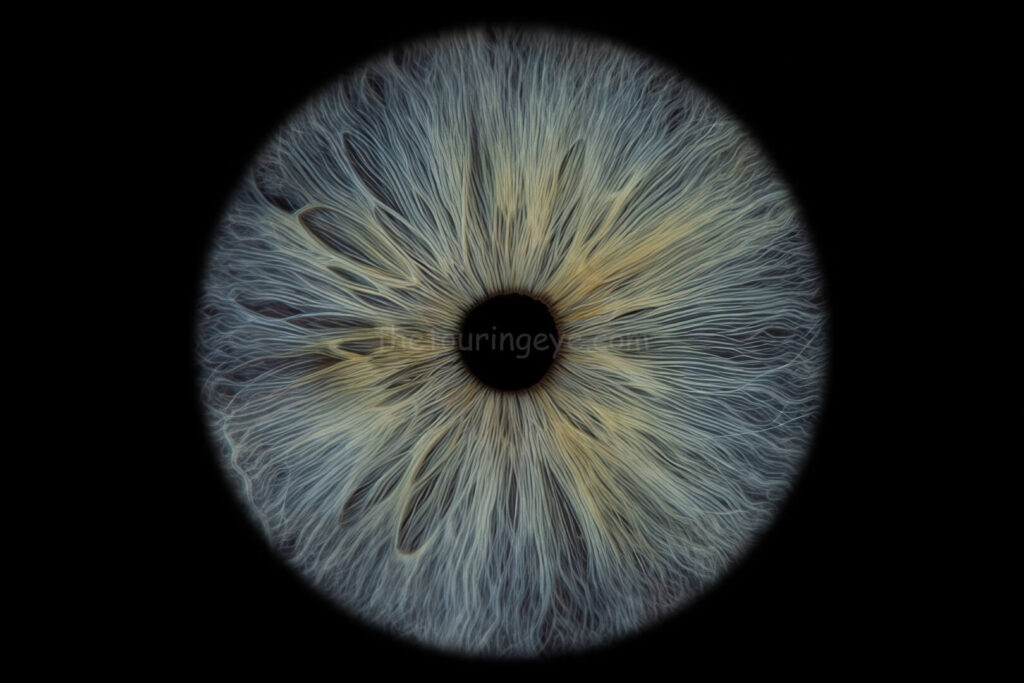
Grey eyes are usually considered less common than blue or brown eyes. In some datasets, grey eyes are counted with blue because they are often produced by similar low-melanin and light-scattering effects.
This means the “blue” category in some studies may actually mean “blue and grey”. That is important. A person with steel-grey eyes may not describe themselves as blue-eyed, but a dataset might still place them in a broader blue-grey group.
Again, classification matters. Statistics are only as useful as the labels behind them. Otherwise we are just putting biological complexity into tidy boxes and pretending the boxes are not held together with duct tape.
Is eye colour genetic?
Yes, eye colour is strongly influenced by genetics, but not in the simple way many of us were taught at school.
The old classroom version often went something like this: brown is dominant, blue is recessive, and two blue-eyed parents cannot have a brown-eyed child. That is far too simplistic.
Modern genetic research shows that eye colour is influenced by many genetic regions, not just one gene. The OCA2 and HERC2 region is especially important for blue-brown eye colour, but it is not the whole story. Large genome-wide studies have identified many genetic loci associated with human eye colour.
In plain English: your eye colour is inherited, but it is not controlled by one neat little genetic switch behaving politely for GCSE biology diagrams.
This is why families sometimes produce eye colours that seem surprising. Genetics is not magic, but it is more complicated than “Mum has blue eyes, Dad has brown eyes, therefore baby comes out as a spreadsheet.”
Do babies’ eyes change colour?
Yes, babies’ eye colour can change, especially during early childhood.
Some babies are born with blue or greyish eyes that darken as more pigment develops in the iris. Others are born with brown eyes and remain brown-eyed. Not all babies are born with blue eyes, despite that myth doing the rounds with the stubbornness of glitter in a carpet.
A child’s final eye colour may settle during infancy or early childhood, although minor changes in appearance can still happen later due to lighting, pupil size, age, health conditions or medication. A sudden or noticeable change in eye colour in adulthood should be checked by an optometrist or medical professional, because while eyes are beautiful, they are also useful and we should avoid treating them like decorative marbles.
Does eye colour affect vision?
For most people, eye colour does not determine how well they can see. Blue-eyed people do not automatically have better or worse eyesight than brown-eyed people.
However, melanin does affect how much light is absorbed in the eye. People with lighter eyes may be more sensitive to bright light because they have less pigment in the iris. That does not mean blue eyes are defective; it simply means some people with lighter eyes may squint dramatically in sunlight while pretending they are fine.
Eye health is far more influenced by factors such as age, genetics, UV exposure, general health, smoking, diabetes, family history and regular eye care. Eye colour alone is not a reliable health forecast.
Why does eye colour matter for iris photography?
For iris photography, the “most common” eye colour is less important than the structure, pattern and contrast inside the iris.
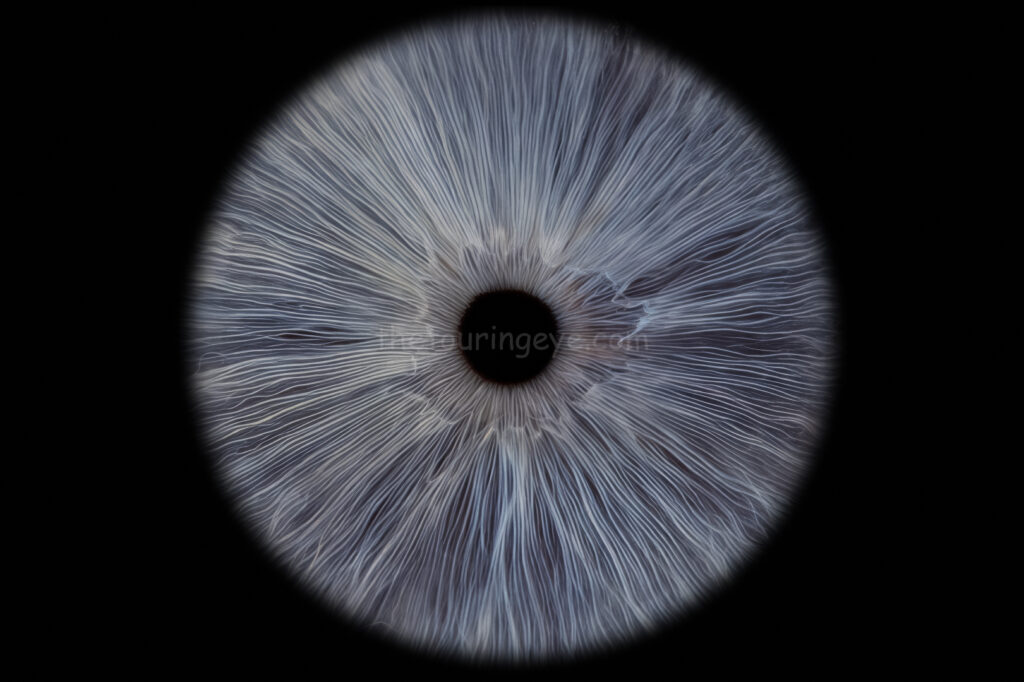
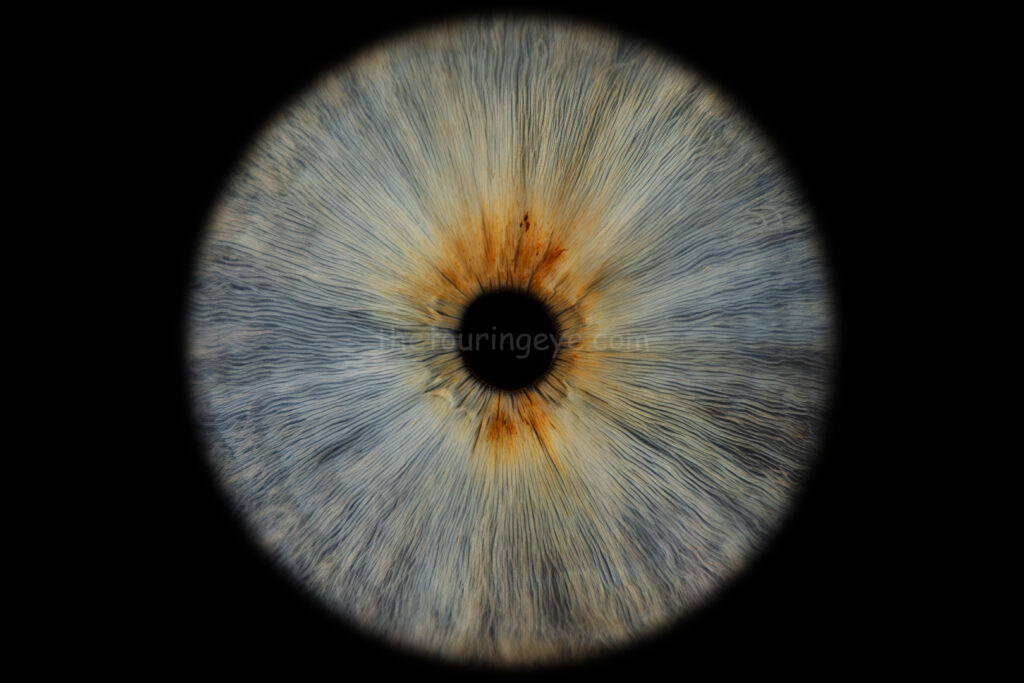
Blue eyes often photograph beautifully because their fibres, rings and darker outer edges can stand out clearly under controlled lighting. Brown eyes can reveal remarkable depth, texture and golden tones when lit correctly. Green and hazel eyes often produce dramatic colour transitions, especially where amber, olive, brown and green overlap.
This is one of the reasons iris photography is fascinating: two people can both have “blue eyes” and yet their irises may look completely different. One may have pale blue radial fibres, another may have deep navy rings, another may have yellow flecks, and another may have central heterochromia.
The label tells you the broad colour family. The iris itself tells you the interesting story.
So, what is the most common eye colour in the UK?
The best cautious answer is:
Blue is likely the most common eye colour in the UK, based on available estimates for Britain and Great Britain.
However, exact percentages vary because:
- there is no official UK eye-colour census;
- “UK”, “Britain” and “Great Britain” are not always used consistently;
- grey may be counted with blue;
- hazel may be counted with brown;
- green, amber and hazel may be grouped as “intermediate”;
- eye colour exists on a spectrum, not in neat little paint-pot categories.
Based on the available sources, blue appears to be the leading eye-colour category in Great Britain, while brown remains the most common eye colour globally.
Frequently asked questions
What is the most common eye colour in the UK?
Blue is likely the most common eye colour in the UK, although the strongest available figures are for Britain or Great Britain rather than a modern official UK-wide census.
What percentage of people in Britain have blue eyes?
Published estimates vary. One literature review gives Great Britain as approximately 42.8% blue or grey-eyed. Another widely cited 2014 estimate reported Britain as 48% blue-eyed. These figures use different sources and classifications, so they should be treated as estimates.
Are brown eyes rare in the UK?
No. Brown eyes are not rare in the UK. They are very common, especially when hazel or light brown eyes are included in the same broader category. Brown is also the most common eye colour worldwide.
Are green eyes rare in the UK?
Green eyes are rarer globally, but they are more common in parts of Europe, including the UK, than in many other parts of the world. Exact UK percentages are difficult to pin down because green is often grouped with hazel or other intermediate colours.
Are blue eyes actually blue?
No. Blue eyes do not contain blue pigment. They appear blue because of low melanin levels in the iris and the way light scatters through the iris structure.
Can two blue-eyed parents have a brown-eyed child?
It is uncommon, but eye-colour inheritance is more complex than the old “brown dominant, blue recessive” model. Multiple genes influence eye colour, so simple inheritance charts do not explain every real-world outcome.
Final answer
The most common eye colour in the UK is most likely blue, but the honest answer needs a small asterisk attached to it. There is no official UK census of eye colour, and different studies classify blue, grey, green, hazel and brown eyes in different ways.
The best available estimates suggest that blue or blue-grey eyes are the largest eye-colour group in Great Britain. Brown eyes remain the most common worldwide, but Britain is one of the places where lighter eye colours are unusually common.
So, if someone asks, “What is the most common eye colour in the UK?” the sensible answer is:
Blue — probably. But exact percentages depend on the source and how eye colours are grouped.
Not as punchy as a fake statistic, granted. But considerably less likely to be nonsense.
Source notes and citation key
The article’s UK answer is based mainly on Katsara and Nothnagel’s 2019 literature review, which lists Great Britain at 42.80% blue, 25.46% intermediate, and 31.77% brown using grouped categories.
The widely repeated 48% blue / 30% green / 22% brown British estimate comes from reporting on the 2014 Blue Eyes Project/ScotlandsDNA material. I’ve treated it cautiously because it is useful context, but not the same as a modern official UK-wide dataset.
The genetics section is supported by current eye-colour genetics research showing that eye colour is complex and influenced by many loci, not just a simple one-gene dominant/recessive model.
The explanation that eye colour is influenced by melanin, with blue eyes having much less pigment and appearing blue through light scattering, is supported by ophthalmology/genetics sources.
For global context, brown is consistently reported as the most common eye colour worldwide, while green is among the rarer common eye colours globally.
Leave a Reply
You must be logged in to post a comment.