

Central Heterochromia vs Hazel Eyes Explained
If you have ever stared into a mirror wondering whether your eyes are hazel or if you have central heterochromia, welcome to one of the internet’s favourite eye-colour identity crises.
You are not alone.
Millions of people search terms like:
- “Do I have hazel eyes or central heterochromia?”
- “What is central heterochromia?”
- “Why do my eyes have two colours?”
- “Are hazel eyes rare?”
- “Is central heterochromia dangerous?”
And honestly, it is not surprising. Eye colour is far more complicated than the simplistic “blue, brown or green” nonsense we were taught as children. Human irises are biological artwork. Tiny muscles, pigments, collagen fibres and light scattering all gang up together to create colours that confuse even opticians sometimes.
Throw in social media filters, over-edited photographs and people diagnosing themselves via a blurry bathroom selfie taken under a fluorescent bulb from 2007 and suddenly everybody thinks they have mystical wizard eyes.
So let us clear this up properly.
What Is Central Heterochromia?
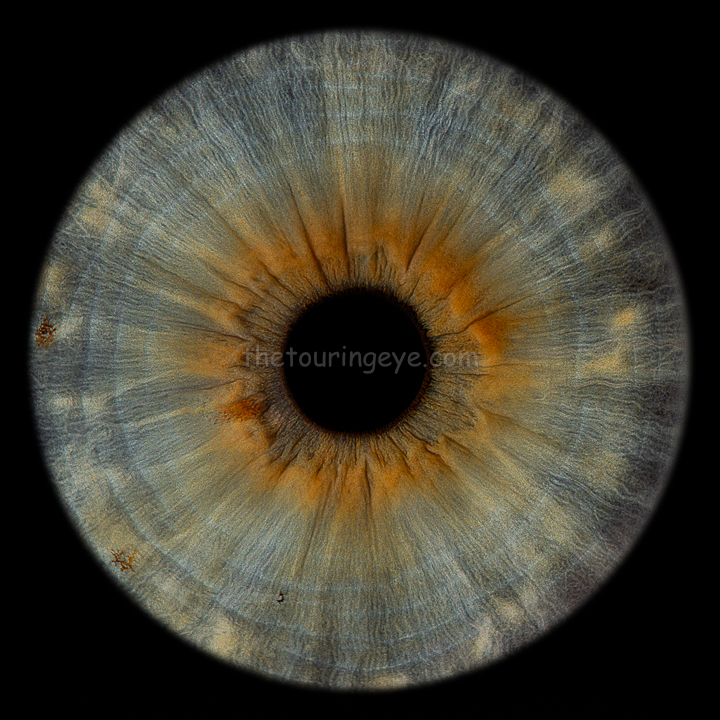
Central heterochromia is a distinct variation in eye colouring where there are two clearly separate colours within the iris.
Typically, this appears as:
- An inner ring of gold, amber or brown around the pupil
- A different outer iris colour such as blue, green or grey
The key detail is this:
The colours appear as defined zones, not blended together evenly.
For example:
- A blue eye with a sharp amber ring around the pupil
- A green iris with a golden centre
- A grey eye with a copper-coloured inner circle
The transition between colours is often obvious rather than gradual.
This happens because melanin pigment — the natural pigment responsible for eye colour — is distributed unevenly within the iris.
Think of it like somebody started painting the eye and changed paint halfway through. Nature occasionally enjoys showing off.
What Are Hazel Eyes?
Hazel eyes are completely different.
Rather than having clearly separated colour zones, hazel eyes usually contain a blended mixture of colours throughout the iris.
Common colours found in hazel eyes include:
- Green
- Gold
- Brown
- Amber
- Copper
Unlike central heterochromia, these colours tend to:
- Mix together gradually
- Shift appearance depending on lighting
- Change visually depending on clothing or surroundings
This is why people with hazel eyes often hear:
- “Your eyes look green today.”
- “I thought your eyes were brown.”
- “Hang on… were they gold a minute ago?”
Hazel eyes are basically the mood rings of eye colours.


The Main Difference Between Central Heterochromia and Hazel Eyes
The simplest explanation is this:
| Central Heterochromia | Hazel Eyes |
|---|---|
| Two distinct colour zones | Mixed blended colours |
| Clear ring around pupil | No sharp separation |
| Colour contrast is obvious | Colours merge together |
| Usually stable in appearance | Often changes with lighting |
| Often mistaken for hazel | Frequently confused online |
If you can clearly identify:
- one colour around the pupil
- and another separate colour around the outer iris
…you may have central heterochromia.
If the colours appear mixed, scattered or blended throughout the eye, they are more likely hazel.
Simple in theory.
Far less simple once TikTok discovers ring lights.
Why Do People Confuse Them?
Because the human eye is absurdly complicated.
Lighting changes everything.
An iris photographed:
- in sunlight
- with flash
- under LED lighting
- near a window
- with professional macro photography
…can appear dramatically different.
As someone working professionally in iris photography, this becomes obvious very quickly. The same eye can look:
- green in one image
- amber in another
- almost blue in cooler lighting
People are often shocked when they see a properly lit macro image of their iris for the first time. Suddenly there are colours, textures and details they never knew existed.
Quite frankly, the human eye is showing off again.
Want to see what details your eye is hiding?
Check out my currently confirmed events on the link below, or sign up for my newsletter if I don’t currently have an event scheduled in your area to ensure you’re notified of new events in the future.
The Science Behind Eye Colour
Eye colour is determined primarily by:
- Melanin concentration
- Collagen structure in the iris
- Light scattering
- Genetics
Contrary to popular belief, blue eyes do not actually contain blue pigment.
That colour is created through a phenomenon called Rayleigh scattering, where light scatters through the iris structure similarly to why the sky appears blue.
Brown eyes contain more melanin.
Green and hazel eyes sit somewhere in between.
Central heterochromia happens when melanin distribution varies across different regions of the iris.
The iris itself is an incredibly complex muscle structure made up of:
- radial fibres
- crypts
- contraction furrows
- pigment cells
Which sounds suspiciously like somebody describing an alien planet rather than part of your eyeball.

Is Central Heterochromia Rare?
Yes — but not extraordinarily rare.
True complete heterochromia (where each eye is entirely different colours) is much rarer and often gets all the attention online because humans collectively lose their minds over symmetry breaking.
Central heterochromia is more common than people realise.
It simply goes unnoticed because:
- most people never examine their eyes closely
- smartphone cameras historically lacked detail
- people rarely see their irises under controlled lighting
Professional iris photography has massively increased awareness of conditions like central heterochromia over recent years.
Suddenly people are discovering: “Wait… my eyes are doing WHAT?”
Are Hazel Eyes Rare?
Hazel eyes are considered relatively uncommon globally.
Brown eyes dominate worldwide, followed by blue.
Hazel eyes are estimated to occur in roughly 5% of the global population, though exact figures vary depending on the study and population group.
They are more commonly found in:
- Europe
- North Africa
- the Middle East
- people with mixed ancestry backgrounds
Their rarity and colour-changing appearance are part of why people find them so fascinating.
Also, humans are biologically programmed to notice unusual features. Evolution decided novelty was interesting long before Instagram arrived to monetise it.
Can You Have Both Hazel Eyes and Central Heterochromia?
Yes.
And this is where things become gloriously confusing.
Some people genuinely have:
- hazel eyes overall
- with central heterochromia within them
For example:
- a hazel iris
- with a stronger amber ring around the pupil
Eye colour exists on a spectrum rather than in neat labelled boxes.
Nature rarely respects human categorisation systems.
Which is probably why biology teachers drink.
Is Central Heterochromia Dangerous?
In most cases, no.
Central heterochromia is usually:
- harmless
- genetic
- present from birth
However, sudden changes in eye colour should always be assessed by a medical professional.
Rarely, changes in pigmentation can be linked to:
- eye injury
- inflammation
- certain medications
- glaucoma
- Horner syndrome
- Fuchs heterochromic iridocyclitis
If you notice:
- sudden colour changes
- pain
- vision changes
- unequal pupils
- inflammation
…do not rely on TikTok comments saying:
“OMG same bestie.”
Please see an actual optician or ophthalmologist.
In the UK, the NHS website and the Royal College of Ophthalmologists provide reliable medical guidance.
Why Iris Photography Reveals So Much Detail
Professional iris photography uses:
- macro lenses
- controlled lighting
- specialised focus techniques
- high-resolution image capture
This reveals details invisible to the naked eye, including:
- pigment variation
- iris fibres
- crypts
- contraction furrows
- colour gradients
- central heterochromia patterns
Most people have never truly seen their own iris in detail before.
And honestly, many reactions fall somewhere between:
“That is beautiful”
and
“Why does my eye look like a volcano made of spaghetti?”
Both are valid responses.
Common Myths About Central Heterochromia and Hazel Eyes
“Hazel eyes change colour completely”
Not exactly.
Lighting, pupil size, clothing colours and surroundings affect how hazel eyes appear, but the actual pigment structure does not magically change.
Your eyes are not shape-shifting according to your mood like some supernatural Netflix teenager.
“Central heterochromia means you have two eye colours”
Sort of.
You have two colour regions within one iris, but it is not the same as complete heterochromia where each eye differs entirely.
“Only rare eyes have central heterochromia”
False.
Many people have mild forms without realising it.
“Brown eyes are boring”
Absolutely not.
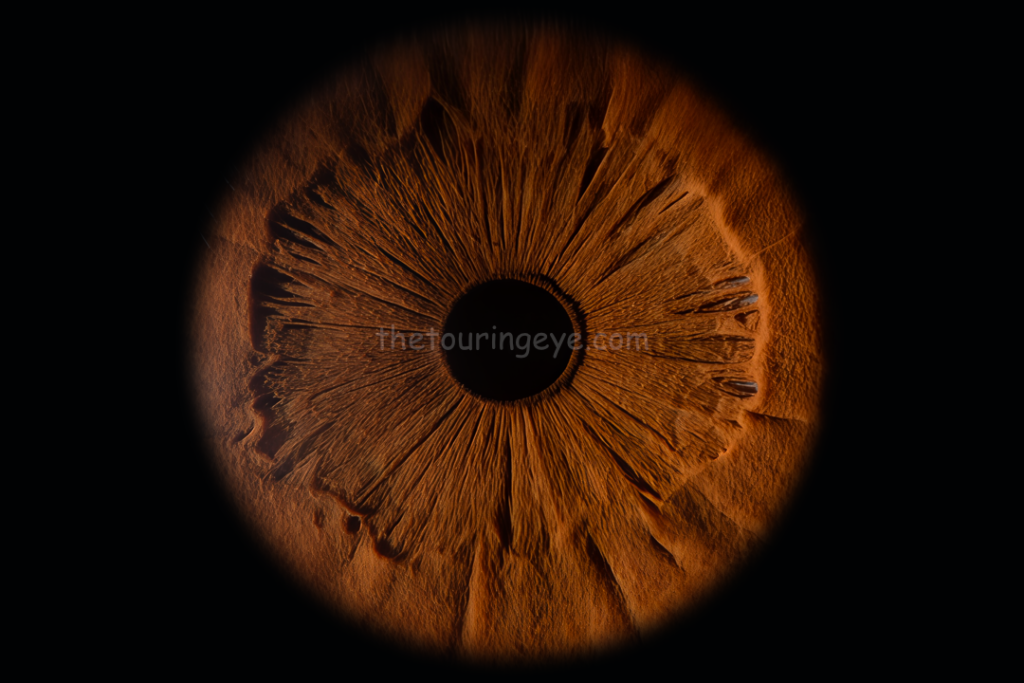
Under macro photography, brown irises often reveal:
- gold fibres
- black crypts
- amber streaks
- copper tones
- intricate textures
Every iris is unique.
Nature did not mass-produce eyeballs in a grey warehouse somewhere.


So… Which Do You Have?
A quick rule of thumb:
You may have central heterochromia if:
- there is a clearly defined inner ring
- the centre colour contrasts strongly
- the colours appear layered
You may have hazel eyes if:
- colours blend throughout the iris
- the appearance changes often in different lighting
- there is no obvious colour separation
And yes:
you can absolutely have elements of both.
Biology loves nuance. Humans prefer labels. Chaos ensues.
Final Thoughts
The confusion between central heterochromia and hazel eyes exists because eye colour is not simple.
It is influenced by:
- genetics
- pigment
- light
- anatomy
- perception
- photography
- environment
And occasionally by somebody using a £12 ring light from Amazon while claiming their eyes are “ultra rare galaxy wolf hybrid eyes.”
At the end of the day, whether your eyes are:
- hazel
- green
- blue
- amber
- grey
- centrally heterochromatic
- or impossible to categorise without a committee meeting
…the human iris remains one of the most intricate and fascinating structures in the body.
Which is precisely why people become so obsessed with seeing it properly for the first time.
Leave a Reply
You must be logged in to post a comment.